top of page

Who wins and who loses under Labour’s capital gains tax

Writer: Kieran Trass
Kieran Trass
13 minutes ago
3 min read

Author: Kieran Trass

Head of Research, Staircase.

Property cycle analyst and author of five books on the New Zealand market.

Labour’s capital gains tax rewards people who hold property and charges people who sell. That is the pattern I found when I tested the policy against its own stated aims in the first Housing Compass report.


Three groups come out ahead and seven carry the cost.


First home buyers land on both sides.


The tax in one paragraph


Summary card of Labour's proposed capital gains tax. Rate: 28 percent, flat, on the gain, not adjusted for inflation. Start: 1 July 2027, only gains after this date count. Death is not a sale, so no tax when a property passes to a partner or heirs. Covered: residential investment property and commercial property when sold. Exempt: the family home including lifestyle blocks, farms, KiwiSaver, shares, business assets, inheritances, gifts and personal items. Starting value: rateable value by default or a registered valuation. Costs: purchase price and improvements come off the gain, rates and interest do not, losses carry forward against future property gains only. Small business selling its premises to buy bigger ones pays no tax. Every dollar goes to health, starting with three free doctor's visits a year.
Labour's capital gains tax as written on the party's policy page and policy document, read 8 October 2026. An election proposal, not law.

Labour proposes a flat 28% tax on the gain when the owner sells a residential investment property or a commercial property. Only gains made after 1 July 2027 count. The family home, farms, KiwiSaver, shares, business assets and inheritances are exempt. The gain is not adjusted for inflation. Death is not treated as a sale, so no tax is paid when a property passes to a partner or heirs. Labour says the tax will pay for three free doctor’s visits a year. This is an election proposal, not law.


Who is better off, and who is worse off
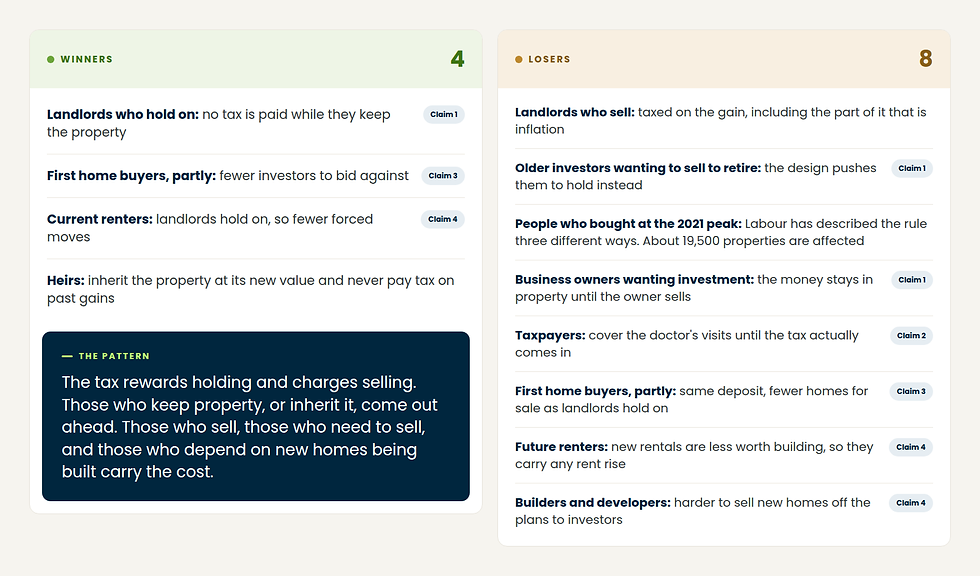

Two-column chart listing winners and losers under Labour's proposed capital gains tax. Four winners: landlords who hold on, first home buyers partly, current renters and heirs. Eight losers: landlords who sell, older investors wanting to sell to retire, people who bought at the 2021 peak, business owners wanting investment, taxpayers, first home buyers partly, future renters, and builders and developers. A note reads: the tax rewards holding and charges selling.
Four groups come out ahead and eight carry the cost under Labour's capital gains tax as written. Source: Housing Compass case study, from Labour's policy page and policy document, read 8 October 2026.

Landlords who sell pay tax on inflation


The tax applies to the whole rise in price after 1 July 2027. Some of that rise is just inflation, not a real gain.


Take a rental worth $800,000 on 1 July 2027. If its price only kept pace with 2% inflation for ten years, it would be worth about $975,000. The $175,000 “gain” is all inflation. At 28%, the owner pays about $49,000 in tax on money that bought nothing extra. These figures are an illustration, not a forecast.


Four-step chain showing how inflation is taxed. Starting value on 1 July 2027: $800,000. After ten years at 2% inflation: $975,000. The gain, entirely inflation: $175,000. Tax at 28%: $49,000. A note reads: tax paid on money that bought nothing extra.
A rental worth $800,000 on 1 July 2027 that only keeps pace with 2% inflation for ten years is worth about $975,000. The $175,000 gain is all inflation, and the 28% tax on it is about $49,000.

Older investors have a reason not to sell


An investor who sells to fund their retirement pays the tax. One who keeps the property until they die pays nothing. That gives older investors a strong reason to hold on, which is the opposite of what Labour says it wants.


Side-by-side comparison of two choices for one investor who owns a rental worth $800,000 on 1 July 2027. Choice one, she sells in 2032 to put the money into a business: 28 percent tax on the gain since July 2027, labelled the move Labour wants. Choice two, she holds on until she dies: zero tax, ever, because death is not a sale and her heirs inherit at the new value, labelled the move the tax rewards.
The same investor and the same $800,000 rental. Selling in 2032 to fund a business is taxed at 28 percent on the gain. Holding until death is taxed at nothing.

2021 peak buyers face an unclear rule


People who bought near the 2021 peak may own properties still worth less than they paid. Labour has described how those owners would be treated in three different ways. Cotality data reported by the NZ Herald on 21 September 2026 put the number of affected properties at about 19,500. The Housing Compass suggests writing a single rule for these owners into the policy document itself, so there is one version rather than three.


Builders and future renters carry a cost


The tax lowers the return on buying or building a new rental. That makes it harder for builders to sell new homes off the plans to investors. If fewer new rentals get built, future renters carry any rent rise. Labour says rents will not go up, but it has not looked at new rentals, which is where any rent effect would come from.


Why the pattern is important


Labour says the tax will move money out of property and pay for three free doctor’s visits a year. A tax that rewards holding works against both aims. Money stays where it is, and the tax only arrives when someone sells.


The Housing Compass tests each of Labour’s claims against the policy as written. It is not a verdict on whether a capital gains tax is right or wrong.


Comments

Rated 0 out of 5 stars.
No ratings yet

Add a rating

This publication has been provided for general information only. Although every effort has been made to ensure this publication is accurate the contents should not be relied upon or used as a basis for entering into any products described in this publication. To the extent that any information or recommendations in this publication constitute financial advice, they do not take into account any person’s particular financial situation or goals. We strongly recommend readers seek independent legal/financial advice prior to acting in relation to any of the matters discussed in this publication. No person involved in this publication accepts any liability for any loss or damage whatsoever which may directly or indirectly result from any advice, opinion, information, representation, or omission, whether negligent or otherwise, contained in this publication.

bottom of page