
New Zealand GDP Surprises on the Upside. But What Happens Next?

Updated: Sep 17
 | Author: Kieran Trass Head of Research, Staircase. Property cycle analyst and author of five books on the New Zealand market. |
New Zealand's GDP rose 0.8% in the March 2026 quarter, following a revised 0.5% rise in the December 2025 quarter. Annual growth was also 0.8%, led by manufacturing. The result confirms the economy was recovering before the mid-2026 oil shock, though the full impact will not appear until later quarters. |
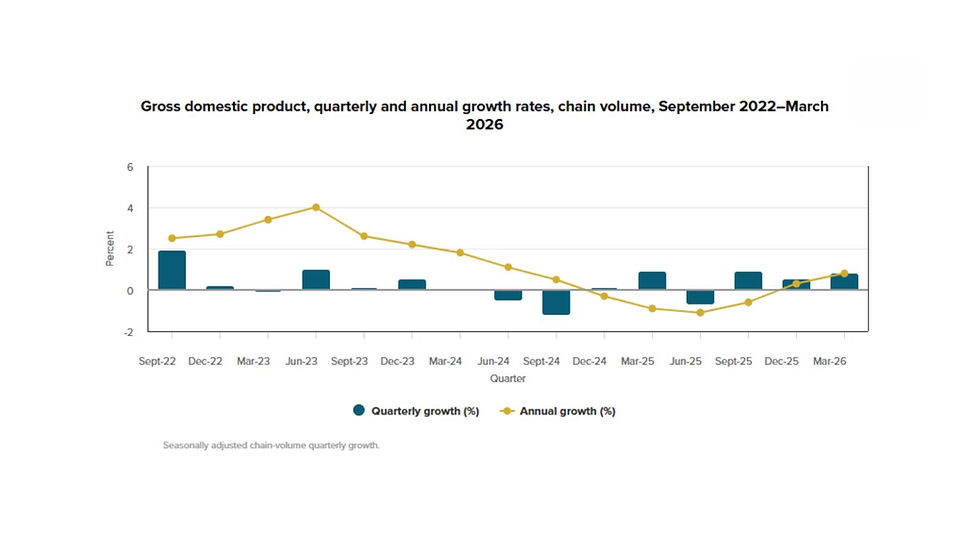
New Zealand's economy has delivered a stronger than expected start to 2026.
Statistics New Zealand reported GDP growth of 0.8% for the March quarter, ahead of the revised 0.5% growth recorded in the December quarter and confirming that the economy entered 2026 with more momentum than many commentators expected.
Annual GDP growth was also 0.8%, and recent revisions to earlier data painted a stronger picture of economic activity than previously understood.
On the surface, this looks like welcome news.
Consumers were spending more. Manufacturing activity improved, lifting 1.9% to become the largest contributor to growth. Tourism continued recovering. Businesses were beginning to respond to lower interest rates. After a difficult period, parts of the economy were finally showing signs of life again. Nine of the 16 industries Stats NZ tracks recorded an increase in activity over the quarter.
However, investors should be careful not to assume this means the challenges facing the economy have disappeared.
The GDP Number Has a Significant Catch
The March quarter only captures economic activity up to the end of March.
That means most of the impact from the Middle East conflict, the resulting oil price spike, and the increase in global uncertainty has yet to show up in the official GDP figures.
Many economists have described the result as a snapshot of the economy before the full effects of the oil shock began flowing through to households and businesses. The more significant economic impacts are expected to appear in the June and September quarter data later this year.
In other words, the result tells us where the economy was heading before the latest external shock arrived.
It does not necessarily tell us where it is going.
What Does This Mean for Mortgage Rates?
Over recent months, some economists had been questioning whether the Reserve Bank might need to pause its easing cycle or even consider future rate increases if economic growth accelerated too quickly.
The March quarter result supports the view that the economy was recovering faster than many expected.
However, monetary policy is determined by where inflation is likely to go, not where GDP was three months ago.
The Reserve Bank has repeatedly indicated that it is focused on forward looking risks. The oil shock presents a difficult balancing act. Higher fuel prices can push inflation higher, but they can also slow economic activity by reducing household spending power and increasing business costs.
That means the GDP result alone is unlikely to trigger a more aggressive Reserve Bank response.
Instead, policymakers will be watching closely to see whether the economic recovery remains intact as the effects of higher energy prices work their way through the system.
When Is the Next OCR Decision?The Reserve Bank's next Official Cash Rate review is on 8 July 2026. This GDP release is the last major piece of economic data before that decision, but with the Reserve Bank focused on forward looking inflation risks rather than past growth, the result is unlikely to shift its path on its own. |
What Does This Mean for Property Investors?
For property investors, the March quarter result is broadly positive.
Strong GDP growth generally supports employment, wages, consumer confidence and housing demand.
Importantly, the recovery that Staircase has been highlighting for many months became increasingly visible in the broader economic data.
Migration has recovered from its lows, according to Stats NZ population data.
Interest rates have fallen substantially from their peaks following the Reserve Bank's easing cycle.
Building activity is slowing, with construction down over the quarter.
Housing supply growth is expected to moderate over coming years, a trend tracked in the Cotality (formerly CoreLogic NZ) Housing Chart Pack.
And now GDP growth has accelerated.
None of these factors individually create a property cycle.
Together, however, they are consistent with the early stages of an economic and housing market recovery.
The Bigger Picture
The most important takeaway from the announcement is not that GDP grew by 0.8%.
The important point is that New Zealand's economy had already begun recovering before the oil shock arrived.
That gives the economy a stronger starting position than many feared.
The next challenge is determining how much of that momentum survives the global uncertainty that has emerged over recent months.
For property investors, this reinforces a message we have been making for some time.
The headlines remain cautious.
Many commentators remain focused on the weakness of the past few years.
But the underlying economic data increasingly suggests that the foundations for the next phase of the property cycle are already being laid.
The economy appears to have entered 2026 with more strength than expected.
Now we wait to see how much of that strength carries through the rest of the year.
Frequently Asked Questions (FAQ)
How much did NZ GDP grow in the March 2026 quarter?
GDP rose 0.8% in the March 2026 quarter, with annual growth also at 0.8%, according to Stats NZ.
Why is the March 2026 GDP result better, or worse, than it looks?
The quarter ended before the mid-2026 oil shock, so the figure reflects the economy before that external pressure arrived. The larger effects are expected in the June and September quarters.
What does the GDP result mean for mortgage rates?
The Reserve Bank sets rates on where inflation is heading, not past GDP, so a single strong quarter is unlikely to change its path. The next OCR review is 8 July 2026.
Disclaimer: This article is general information only. It does not take into account your personal financial situation, goals or circumstances, and it is not financial advice. Before making any property or financial decision, consider seeking advice from a licensed financial adviser.


Comments